"Us and Them: Do You Read Me?"
Two weeks before Common Tests. While most of the school shifted gears and buried their heads in books, a rag-tag group of amateur actors rehearsed within the cosy confines of the Play Den at the Arts House. Studies could wait, for three days at least.
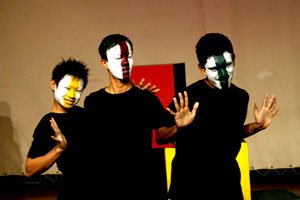
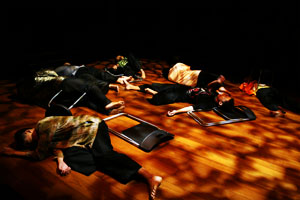
For our annual production we, the Raffles Players, got ambitious and chose to perform David Campton's "Us and Them", with the inclusion of four original scenes written by members of the group. It turned out to be an abstract, experimental play that was highly physical. The actors were challenged to their limits, not just with memorizing lengthy chunks of script, but physically as well, what with balancing on each other's legs and miming at the same time.
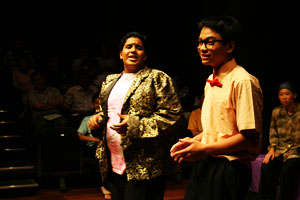
"Us and Them: Do You Read Me?" explored the conflicts that occur between two groups, and the inevitable wall that they create to separate themselves. When the wall is pulled down, it is only to give way for war. Consequently the additional scenes probed into specific conflicts that we can all relate to; the frustration of having a popular friend when you're unknown, the seemingly eternal clash of arts versus science, the values of the new generation meeting the old.
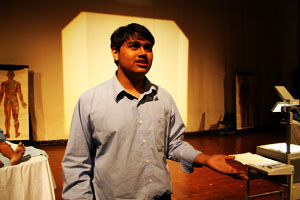
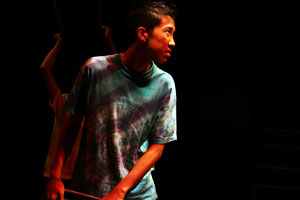
Of special note was Shi Yang, who managed to pull off a small miracle. Two weeks before production he memorized three pages worth of the script, and held the stage alone in a monologue, captivating the audience and being an inspiration. He acted as an old-fashioned baker caught in a maelstrom of changing times, and brought delicious cakes to our rehearsals.
Conceptualization of the script began in mid-November 2005, and the first script reading took place in December. Rehearsals lasted five months, and two weeks before the Common Tests, the crew and cast were down at the Arts House.
The audience watched, laughed and clapped. But the most dramatic experience was not the performance. It was the hours spent in the english studio, in the backstage of the Play Den, in the compact control room fiddling with state-of-the-art lighting and sound equipment. It was the numerous trips to Arab Street, hunting costumes and cloth and parking illegally in the middle of the road, that would be the brunt of jokes.
And it was the way we bonded as a team. In an ensemble play, synergy far exceeds the need to shine. Indeed, there were no stars of the show, no individual glamour, no fighting for the spotlight. We worked and bonded as one, and pretty soon were doing the craziest things together during rehearsal.
As the time of reckoning drew closer, everyone felt the pressure. I observed the various ways in which the cast destressed. Stray mikes were used in bursts of song, the out-of-bounds control room was raided by the cast, and our dear mascot, the Minnie Mouse that had been around for ages, was forced into retirement after being beheaded. The suspect later played doctor, stitching Minnie's head back in place.
So while what the audience enjoyed was the fruit of our labour, we embraced the process. That is why we put up a play. Passion, for the sake of experiencing a different sort of satisfaction, for the love of art. Occasionally, winning isn't everything.
Phua Jun Wei